
Have you started noticing more scalp showing between your braids? Maybe your part looks wider, your edges seem thinner, or you are seeing more hair than usual in your comb or brush. These changes can feel alarming—especially when you do not understand why they are happening.
But let’s remove some of the mystery and put things into perspective. We have had the opportunity to live through 40, 50, or more years of changing seasons, responsibilities, relationships, environments, and life experiences. Our hair does not live separately from the rest of us. What affects the body can sometimes affect the hair, too.
Stress, illness, surgery, significant weight changes, certain medications, hormonal shifts, nutritional concerns, repeated tension, and years of styling practices can all play a role in changes we see or feel. Even our daily environment—weather, indoor heat, sun exposure, and humidity—can affect how our hair holds moisture, responds to products, and behaves from one season to another.
Aging and menopause may also affect the hair’s growth cycle, density, and the thickness of individual strands. But we should not automatically dismiss every change as “just getting older.” A widening part, increased shedding, thinning crown, fragile edges, or changes in texture are information. They are reasons to pay closer attention, ask better questions, and seek professional medical guidance when needed. Hormonal changes during menopause have been associated with changes in hair growth and density, while stress, illness, and major life events can contribute to excessive shedding. (aad.org)
This is where hope and self-advocacy come in. Think about the other challenges you have faced throughout your life. You learned, adjusted, asked questions, and made new decisions based on what you knew at the time. We can approach changing hair in much the same way.
Becoming proactive does not mean buying every product that promises growth or blaming yourself for what has changed. It means learning what may be affecting your hair, documenting the changes you notice, consulting the right professionals, adjusting your hair-care and styling practices, and setting realistic goals based on your needs and lifestyle.
We may not be able to restore every strand or reverse every type of hair loss, but we can begin a revised journey—one focused on protecting the hair we have, supporting its healthiest possible condition, and rebuilding a hair-care plan that makes sense for who we are today.
Hair does not always respond to protective styling the way it did ten or twenty years ago. A style that once felt easy and comfortable may now feel too heavy, expose thinner areas, or place more stress around the edges or crown. That does not mean you have run out of beautiful options. It means your style selection should begin with the hair you have today—not the density or strength your hair had years ago.
A Protective Style Should Protect the Hair You Have
The word “protective” does not automatically mean that a hairstyle is gentle. A style may keep the ends tucked away while still placing too much tension or weight on the hairline, crown, or other fragile areas.
Repeated pulling from tight braids, cornrows, ponytails, extensions, weaves, and some loc styles can contribute to traction alopecia. The risk is affected by how tightly the hair is pulled and how long that tension continues. Pain should never be treated as proof that a style is neat, secure, or professionally installed.
Pay attention to warning signs such as:
- Pain or a headache during or after styling
- Burning, tenderness, itching, or redness
- Bumps, crusting, or irritation around the follicles
- Excessive pulling around the edges
- Added hair that feels unusually heavy
- Broken hairs or increasing thinning after removing the style
These signs should not be ignored or simply “waited out.” A hairstyle that hurts or visibly stresses the scalp should be loosened or removed.
NHAL provides natural-hair styling education and coverage ideas—not medical diagnosis or treatment. Sudden, worsening, painful, inflamed, or unexplained hair loss should be evaluated by a board-certified dermatologist, preferably one experienced with textured hair and hair-loss conditions.
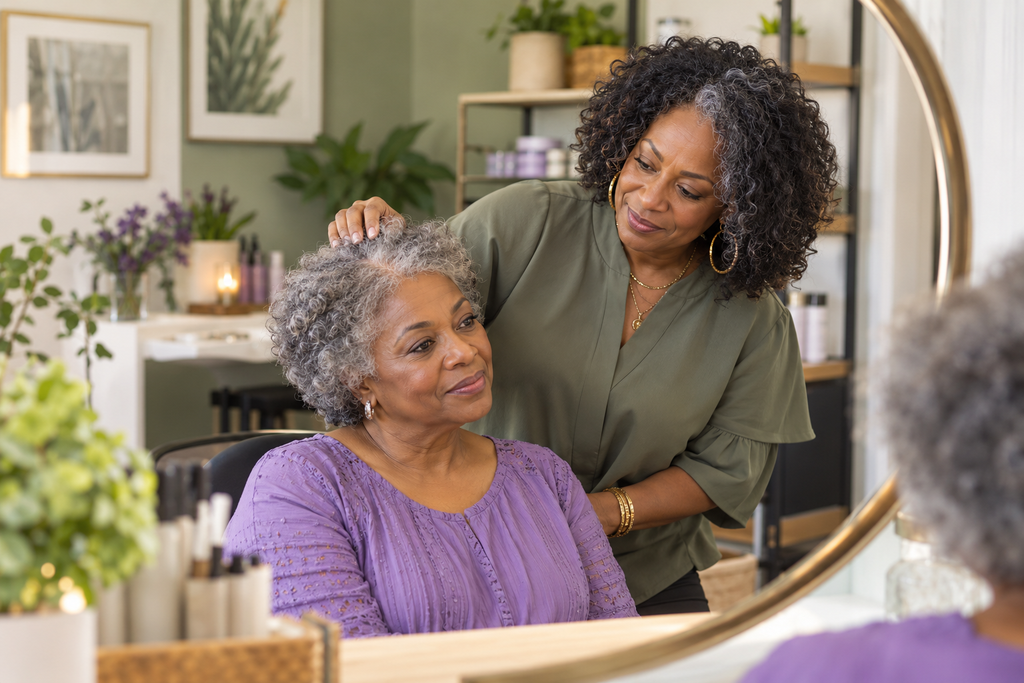
Seven Things to Consider Before Choosing a Style or Stylist
When you notice your hair changing, the natural response may be to start searching for a new product, hairstyle, or professional immediately. Before doing that, take a moment to understand what brought you to this point.
The clearer you are about what you are experiencing and what you want, the better prepared you will be to ask questions, compare options, and decide what feels right for you.
1. What Are You Actually Noticing?
Start by identifying the changes that concern you.
Are you seeing:
- More scalp between your braids?
- A widening part?
- Thinning around the crown or edges?
- More hair in your comb, brush, sink, or shower?
- Short broken hairs?
- Changes in texture or dryness?
- Tenderness, itching, burning, flaking, or bumps?
- A style that suddenly feels heavier or less comfortable?
Try to remember when you first noticed the change and whether it happened gradually or seemed to appear suddenly.
Pictures can help. Take clear photographs of the same areas every few weeks in similar lighting. It can be difficult to judge progress when you look at your hair every day, but photographs may help you recognize whether something is improving, remaining stable, or continuing to change.
2. Why Are You Looking for Help Now?
Sometimes we live with a concern for months—or even years—before something causes us to act.
Ask yourself what changed.
Did the thinning become more noticeable? Did a trusted product stop giving you the results you expected? Did a recent style cause discomfort or breakage? Are you tired of trying to hide the same area? Did you experience an illness, stressful period, medication change, hormonal transition, or significant weight change?
Perhaps you have already spoken with one professional but want another opinion or additional options.
Remembering why you decided to take action now will help you explain your concerns more clearly. It may also help you decide whether you need styling assistance, medical evaluation, a different hair-care routine, or a combination of support.
3. What Outcome Are You Hoping For?
“Fix my hair” can mean many different things.
You may want to:
- Cover a thinning crown
- Reduce stress around fragile edges
- Find a lighter protective style
- Stop manipulating your hair every day
- Make your locs appear fuller
- Find a wig or topper that looks natural
- Learn how to maintain your hair between styles
- Understand whether a style is contributing to breakage
- Feel comfortable and confident again
Try to separate your immediate styling goal from your longer-term hair-health goal.
A protective style may provide coverage or reduce daily manipulation, but it cannot diagnose or treat the cause of hair loss. Knowing what you want the style to accomplish can help you form realistic expectations and avoid purchasing a service or product that does not address your actual concern.
4. What Do You Already Know About Your Hair and Scalp?
A professional may have training, technical knowledge, and years of experience—but you live with your hair and scalp every day.
Only you know that a particular area becomes tender when braided. Only you know that certain products cause itching, that clips feel uncomfortable in a specific location, or that your scalp started behaving differently after a life or health change.
Before meeting with a professional, make notes about:
- Areas that feel sensitive or painful
- Product or material allergies
- Previous reactions to products or extension hair
- Styles that have caused discomfort
- Styles your hair tolerated well
- How long you normally wear protective styles
- Relevant health or medication changes to discuss with your doctor
- Your daily maintenance routine
You may not know all the technical terminology, but your observations are still valuable.
Your professional may be the expert in hair care, styling, or medicine—but you are the expert on what you feel and what you have experienced.
5. What Questions Do You Want Answered?
It is easy to forget your questions once you are sitting in front of someone you consider an expert. Write them down beforehand.
Depending on the service or professional, you might ask:
- What do you notice about the condition and density of my hair?
- Is there enough healthy hair to support this style?
- How much added hair will be used?
- Can the length or fullness be reduced?
- How will you avoid placing tension on my fragile areas?
- What should I do if the style becomes painful?
- How long should I keep the style installed?
- How will I maintain my hair and scalp?
- What is the safest way to remove the style?
- Are there other options I should consider?
- Is this concern outside your professional scope?
A qualified professional should be willing to explain her recommendations in language you understand.
6. What Kind of Professional Relationship Makes You Comfortable?
Some women prefer to tell a stylist their concern and allow her to make the recommendation. Others want a more collaborative experience where the professional explains several options and they make the final decision together.
Neither preference is wrong.
The important question is whether the professional’s communication style matches what helps you feel safe and confident.
When we believe someone knows more than we do, we may become quiet, minimize our discomfort, or agree to something we do not fully understand. Expertise deserves respect, but it should not require you to surrender your voice.
A stylist or natural-hair professional can help with styling, maintenance, tension, placement, extension choices, and coverage options within her professional scope. A dermatologist is the appropriate professional to diagnose and medically treat hair loss or scalp conditions. Sometimes the best support involves both. (www.aad.org)
7. Can You See Yourself Working With This Person Long-Term?
Improving how you care for changing hair is usually an ongoing process, not a single appointment or product purchase.
Consider whether the professional:
- Listens without dismissing your concerns
- Respects your comfort level
- Explains what she sees and recommends
- Welcomes reasonable questions
- Adjusts when you report pain or tenderness
- Avoids shaming you about your hair
- Stays within her professional scope
- Is honest when she does not know the answer
- Encourages medical evaluation when appropriate
- Is willing to modify the plan as your hair changes
You are not only choosing a hairstyle. You may be choosing someone who will support you through a changing-hair journey.
Technical ability matters, but so do trust, communication, patience, and temperament. The right professional relationship should help you feel more informed and confident—not smaller, embarrassed, or afraid to speak.
Protective-Style Options Worth Considering
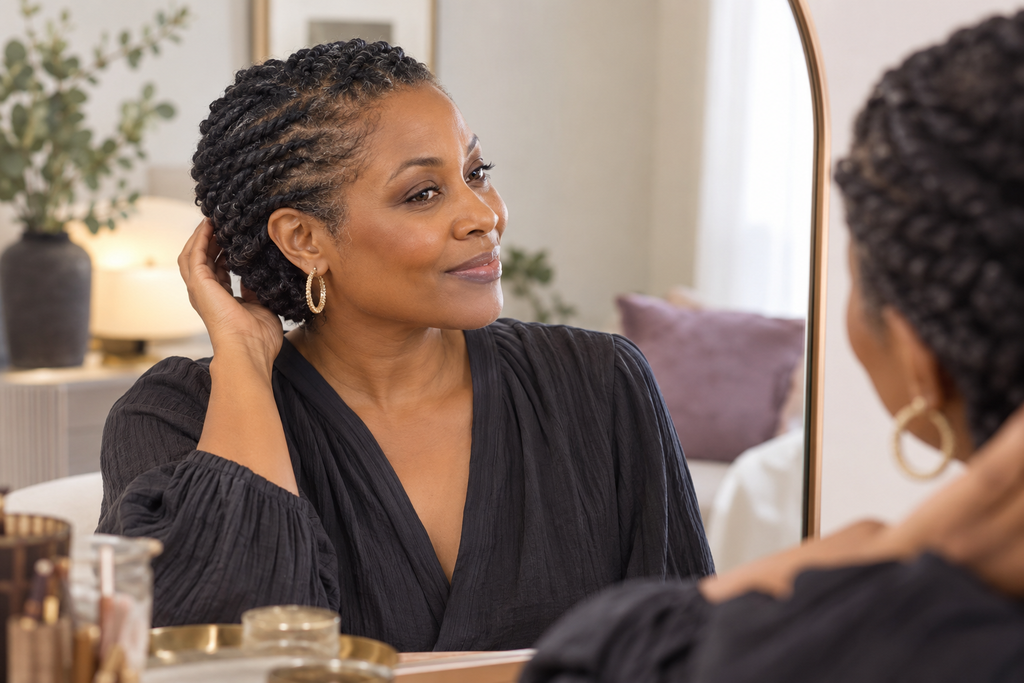
No single protective style is right for every woman with thinning or changing hair. The best option depends on where the thinning occurs, how much healthy hair is available for support, your scalp’s condition, your maintenance preferences, and the amount of coverage you want.
The following styles may be adaptable when they are installed with appropriate tension, weight, placement, and realistic expectations.
Loose Twists and Flat Twists
Two-strand twists and flat twists can offer flexibility without requiring large amounts of added hair. They can be arranged to direct fullness toward a lower-density area or worn beneath a wig or other removable coverage option.
However, flat twists should not be pulled tightly to make thinning areas appear smoother. Fragile edges and sparse sections may need to be left free, loosely incorporated, or styled in a different direction.
Lightweight Crochet Styles
Crochet styles can provide fullness and coverage while limiting the amount of daily manipulation required. The foundation can sometimes be adjusted to avoid placing excessive stress on a fragile crown or hairline.
The added hair should still be selected carefully. Very long, dense, or heavy crochet hair can place unnecessary weight on the braided foundation. A shorter or lighter style may provide attractive coverage with less stress.
Braids With Reduced Length and Fullness
Box braids, knotless braids, and other individual styles do not have to be extremely long or full to be flattering. Using less added hair, choosing a moderate length, and creating appropriately sized sections may reduce unnecessary weight.
“Knotless” should not automatically be interpreted as “tension-free.” The installation technique, size of the sections, amount of extension hair, and condition of the natural hair all matter.
Wigs and Removable Coverage
A properly fitted wig can provide broad coverage without requiring every thinning area to support extension hair. It also offers flexibility because it can be removed for scalp access and maintenance.
Pay attention to how the wig is secured. Tight bands, combs, clips, adhesives, or repeated friction along the same areas can create discomfort or stress. The attachment method should reflect the condition and location of the natural hair underneath.
Toppers and Strategically Placed Hair Additions
Toppers and smaller hair additions may provide targeted fullness without covering the entire head. They can be helpful when the primary concern involves the crown, part, or another specific area.
The attachment points are especially important. Clips and combs need enough healthy hair for support and should not repeatedly pull on a fragile section. Some women may benefit from alternative attachment or integration methods when the surrounding hair is too delicate.
Loc Styling, Repair, and Coverage Options
Women with locs may notice reduced density, weak roots, thinning individual locs, or more visible scalp over time. Depending on the condition of the hair, options may include adjusting the style, repairing selected locs, reducing tension, changing the parting, or exploring removable loc-coverage pieces.
Tight updos and heavy loc additions can place stress on already weakened areas. A loc solution should account for the strength of the roots—not just the finished appearance.
The Technique Matters More Than the Style’s Name
A hairstyle is not automatically gentle because it is described as natural, protective, knotless, lightweight, or low-tension. Those terms describe an intention; they do not guarantee how the style will actually be installed.
The safest choice is one adapted to your current hair—not a standard installation repeated the same way for every client.
When Styling Advice Is Not Enough
Protective styling can help with appearance, coverage, and day-to-day hair management, but it cannot diagnose or treat the reason your hair is thinning.
A natural-hair professional may notice changes in density, breakage, or the condition of the scalp. However, determining whether those changes are related to traction, hormones, medication, nutrition, inflammation, an autoimmune condition, a scalp disorder, or another cause requires an appropriate medical professional.
Consider seeing a board-certified dermatologist if you notice:
- Sudden or rapidly increasing hair loss
- A smooth, round, or sharply defined bald patch
- Thinning that begins or continues to spread from the crown
- Persistent itching, burning, stinging, pain, or tenderness
- Redness, scaling, bumps, sores, crusting, or drainage
- A smooth or shiny-looking area where follicle openings are difficult to see
- Hair loss involving the eyebrows, eyelashes, or other areas
- Continued thinning even after changing tight or stressful hairstyles
These symptoms do not all point to the same condition. That is precisely why professional medical evaluation matters.
One condition dermatologists watch for in Black women is central centrifugal cicatricial alopecia, commonly called CCCA. It often begins around the crown and may include itching, burning, tenderness, bumps, or breakage—but some women have few noticeable symptoms. CCCA can cause permanent scarring hair loss, so earlier evaluation is important. Not every thinning crown is CCCA, and a stylist should never attempt to diagnose it.
The American Academy of Dermatology recommends seeing a board-certified dermatologist for hair loss because there are many possible causes, and finding the cause sooner can improve the opportunity for appropriate care.
Preparing for a Dermatology Appointment
It may be helpful to bring:
- Photographs showing how your hair has changed over time
- A list of medications and supplements
- Relevant health or hormonal changes
- A description of your usual hairstyles and hair-care practices
- The approximate date you first noticed thinning, shedding, or discomfort
- Notes about itching, pain, burning, flaking, or other scalp symptoms
Good styling support and medical care serve different purposes. When needed, they can work alongside one another to help you make informed decisions about both your scalp health and your styling options.
Changing Hair Still Deserves Thoughtful Options
When your hair changes, the styles and techniques that worked in the past may need to change too. That does not mean you have run out of attractive choices—and it does not mean you have to accept pain, excessive tension, or a style that no longer works for your current hair.
A truly protective style should consider:
- The hair and density you have today
- The location of fragile or thinning areas
- The tension and weight created by the style
- How the style will be maintained and removed
- Whether medical evaluation is needed before styling
Sometimes the right adjustment is using less added hair, choosing a shorter length, changing the foundation, or selecting removable coverage. At other times, the best next step is pausing protective styles and speaking with a dermatologist.
Adapting your hairstyle is not giving up. It is making a more informed choice based on where you are now.
Natural Hair & Lifestyle is building a growing collection of practical guidance, professional insights, hairstyle ideas, and trusted resources for Black women navigating thinning, fragile, gray, or changing natural hair.